

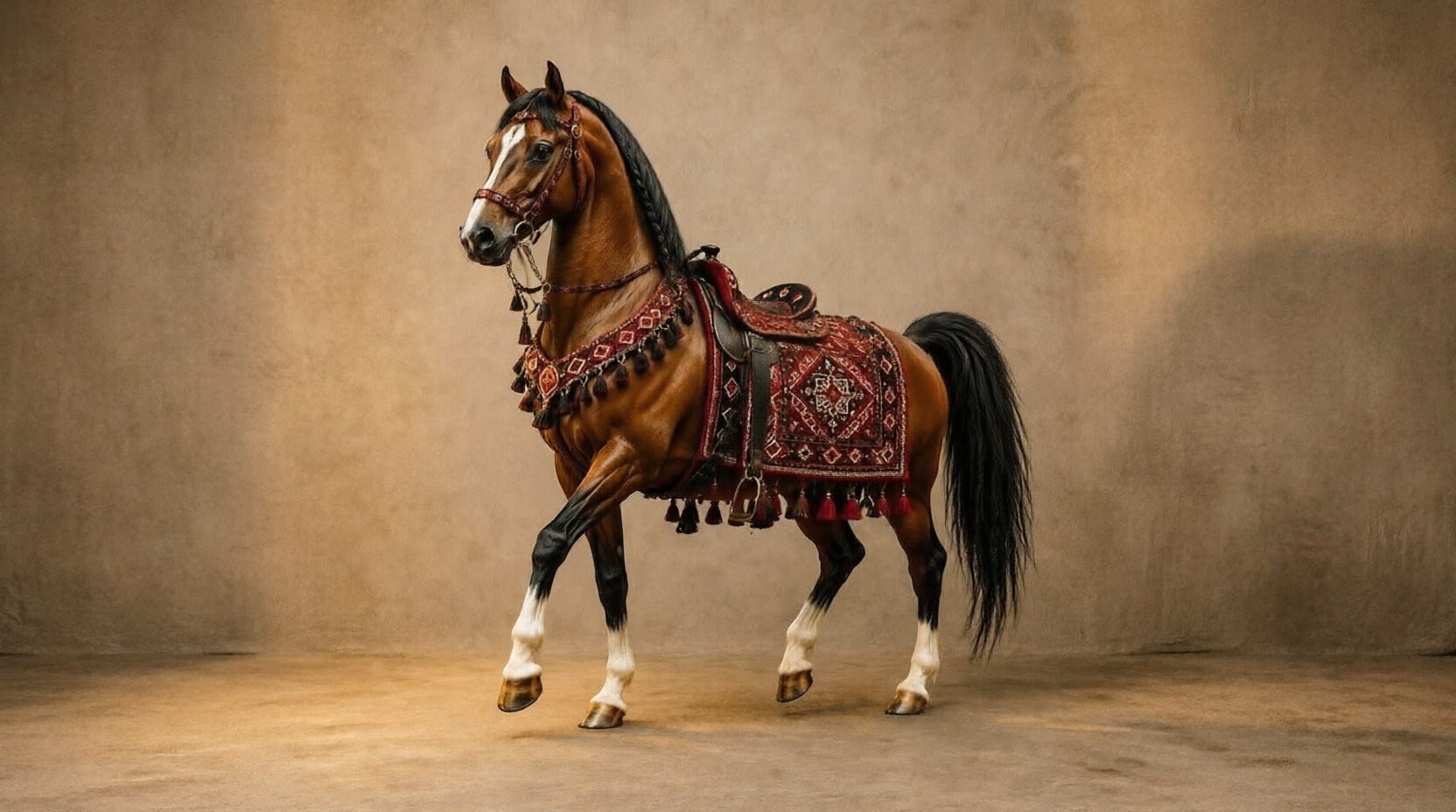
SEMIROM, Isfahan Province — There are horses, and then there are horses that carry the soul of a people on their backs. The Dareshuri belongs firmly to the second category.
This week, the town of Semirom in Iran’s Isfahan province is playing host to a cultural and artistic gathering unlike any other — a multi-day celebration devoted entirely to the Dareshuri horse, the elegant riding breed native to Fars province and inseparable from the identity of the Qashqai nomadic confederacy.
The event brings together an uncommon mix of participants: horse breeders and veterinarians, equestrian riders and researchers, alongside visual artists, calligraphers, musicians, and storytellers. The goal isn’t simply to showcase a beautiful animal. It’s to protect a living thread of Iranian heritage before it frays, while inviting the world to witness it.
More Than a Horse — A Cultural Archive
The Dareshuri — sometimes called the Shirazi horse — is an oriental-type riding horse whose lineage stretches back through generations of selective breeding within the Qashqai tribe, particularly the Dareshuri clan from which it takes its name. Every aspect of the breed, from its endurance to its temperament, was shaped by the demands of nomadic life on the move across southern Iran’s rugged terrain.
Negar Mohammadi Kashkoli, a board member of the Fars Equestrian Federation and a tourism professional helping organise the gathering, describes the Dareshuri as far more than a physical specimen.
“The Dareshuri horse is the product of a long interaction between people, the environment, culture, and selective breeding,” she explained. Its significance, she noted, reaches well beyond conformation and riding ability into historical, cultural, and social territory.
Kashkoli stressed the importance of scientific documentation — studying the breed’s phenotypic traits, genetic profile, and traditional breeding practices — to ensure that what has been passed down through centuries of nomadic life is not lost to modernity.
Art Meets the Saddle
What sets this gathering apart from a typical equestrian show is its artistic heart. Alongside specialist panels and knowledge-exchange sessions, the event features creative workshops spanning traditional textile weaving, calligraphy, painting, live music, singing, and — perhaps most fittingly — recitation from the Shahnameh, Ferdowsi’s epic masterpiece, a text in which horses and heroism are forever intertwined.
The idea, Kashkoli said, is to tell the story of the Dareshuri horse and the culture it represents to a wider audience through every expressive medium available.
Bridging Heritage and Tourism: A New Draw for Travellers
It is no coincidence that Kashkoli bridges the worlds of equestrianism and tourism. For regions like Semirom and the broader Fars province, the Dareshuri horse represents a unique and powerful opportunity to develop sustainable, community-based tourism.
Modern travellers to Iran are increasingly looking beyond the grand mosques of Isfahan and the bustling bazaars of Tehran. Today’s culturally conscious travellers seek immersive, authentic experiences that connect them to the land and its people. Equestrian tourism and nomadic heritage tours allow visitors to step into the living history of the Qashqai people, experiencing the breathtaking landscapes of southern Iran from the back of the very animal that helped shape its history.
By promoting these regional festivals, local organisers are creating a new niche for eco-tourism. Visitors who attend these events contribute directly to the local rural economy, supporting indigenous artisans, local guides, and traditional breeders. Furthermore, because the horse holds a deeply revered place in Islamic tradition—celebrated in the Hadith for its nobility, grace, and utility—events like this offer Muslim travellers a unique way to connect with the rich, diverse tapestry of Islamic heritage in Iran outside of the traditional pilgrimage routes.
Why It Matters for the Curious Traveller
For those who travel seeking something deeper than monuments and museums, gatherings like this offer a rare window into the country’s intangible heritage — the traditions that live not in stone, but in the relationship between a people, their land, and the animals that carried them across it.
The Dareshuri horse didn’t emerge from a laboratory or a stud book. It emerged from campfires, mountain passes, and centuries of movement. And in Semirom this week, Iran is making sure the world remembers that, inviting travellers to saddle up and experience a piece of history that is still very much alive.