

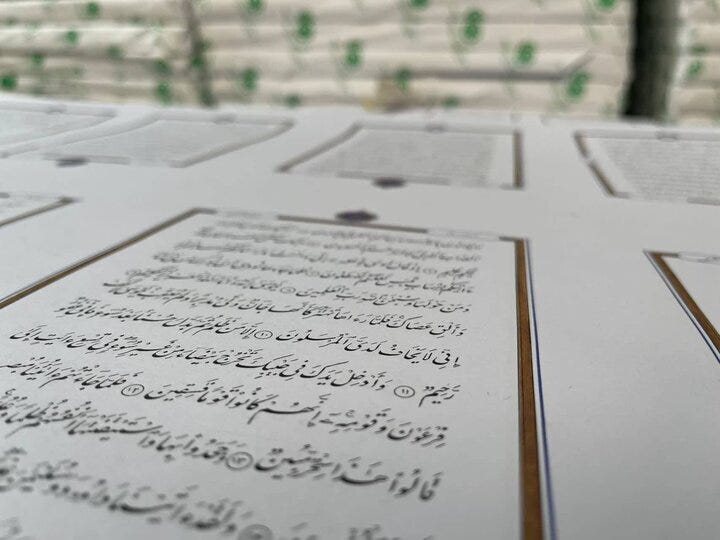
In the world of Islamic calligraphy, the Quran has traditionally been preserved in the Naskh script—a style prized for its clarity and geometric precision. However, a historic shift has just occurred in the heart of Iran. After more than ten years of meticulous devotion, the first complete Holy Quran written in the exquisite Nastaliq script has been published, marking a monumental achievement for both religious scholars and art historians alike.
The Vision of Master Parviz Nikbin
This “exquisite” edition is the work of Master Parviz Nikbin, a distinguished calligrapher who spent over a decade hand-writing every verse. While Nastaliq is often referred to as the “Bride of Islamic Scripts” due to its graceful, hanging curves and rhythmic flow, it is notoriously difficult to use for the Quran because of the complexity of placing Arabic diacritics (vowels) over its sloping letters.
To ensure the text remained spiritually and linguistically accurate, the manuscript underwent four years of rigorous editing and diacritic placement. It has officially been approved by the Dar al-Quran Organisation, ensuring that while the form is artistic, the function remains perfectly suited for recitation.
From South Khorasan to the World
The project, which faced years of financial hurdles, was finally brought to fruition through the support of the South Khorasan Public Libraries Directorate and the Governor of the province, Seyyed Mohammad Reza Hashemi. Published by Chahar Derakht Publications, the work follows the structural style of the world-renowned Master Uthman Taha, making it familiar to readers while offering a distinctly Persian aesthetic.
The choice of Nastaliq is deeply symbolic. Developed in the 13th century, it is the soul of Persian identity, used for centuries to scribe the poetry of Rumi and Hafez. By applying this script to the Quran, the project elevates the “Persian hand” to the service of the Divine Word on a scale never before completed in a full, printed edition.
A Perfect Fit for the Shia Journey
For followers of the Ahlulbayt and those interested in the intersection of faith and art, this publication is more than just a book; it is a pilgrimage of the pen. The official unveiling is expected to take place during the upcoming month of Ramadan—the month of the Quran’s revelation—providing a new way for the faithful to engage with the text through the lens of Iranian spiritual heritage.
As calligraphy is often described by Islamic masters as “the geometry of the spirit,” this Nastaliq Quran stands as a testament to the enduring Shia tradition of honouring the Holy Book through the highest forms of human beauty.
Traveller’s Guide: Where to Witness the Nastaliq Masterpiece
For those planning a spiritual or cultural pilgrimage to Iran, seeing this specific Quran offers a unique window into the “Persian Soul” of Islamic art.
1. The Heartland: South Khorasan. The project was born and funded in South Khorasan Province, located in Eastern Iran. Travellers should head to the provincial capital, Birjand.
The Unveiling: The Quran is scheduled to be officially unveiled during the Holy Month of Ramadan (Spring 2026). During this time, it is expected to be the centrepiece of the provincial Quran Exhibition in Birjand.
Public Libraries: You can find copies and potentially the original manuscript via the South Khorasan Public Libraries Directorate. Their main branches often host “Exquisite Manuscript” galleries.
2. The Publisher: Chahar Derakht (Four Trees) This Quran was published by Chahar Derakht Publications, a house known for preserving regional heritage. They are based in Birjand, and visiting their headquarters or affiliated bookstores in the city is the best way to purchase a printed copy for your own collection.
3. Future Home: The Holy City of Mashhad? While currently rooted in South Khorasan, major works of this calibre often find a permanent home in the Astan Quds Razavi Museum in Mashhad (the neighbouring province). As the largest museum of manuscripts in the Islamic world, it is highly likely that a copy or the original will eventually be gifted to the Shrine of Imam Reza (AS). If you are visiting the Shrine, check the Treasury of Qurans (Ganjineh-ye Quran) section.
Pro-Tip for ShiaJourneys Readers: If you are travelling between Mashhad and the historical sites of Kerman or Yazd, Birjand makes a perfect “off-the-beaten-path” stop. Not only can you seek out this Nastaliq Quran, but you can also visit the Akbarieh Garden (a UNESCO World Heritage site) in the same city.
Why this is a “Shia Journey”
In Shia tradition, the “Thaqalayn” (the Two Weighty Things) are the Quran and the Ahlulbayt. Iranian artists have historically viewed calligraphy as a way to “dress” the Word of God in the finest possible garments. Seeing this Quran in person allows a traveller to move beyond just reading the text and instead witness the labour of love (over 10 years of writing) that a modern master has dedicated to his faith.
It is a reminder that the “journey” of Islam is not just through history, but through the evolving beauty of how we preserve the Divine Message today.