

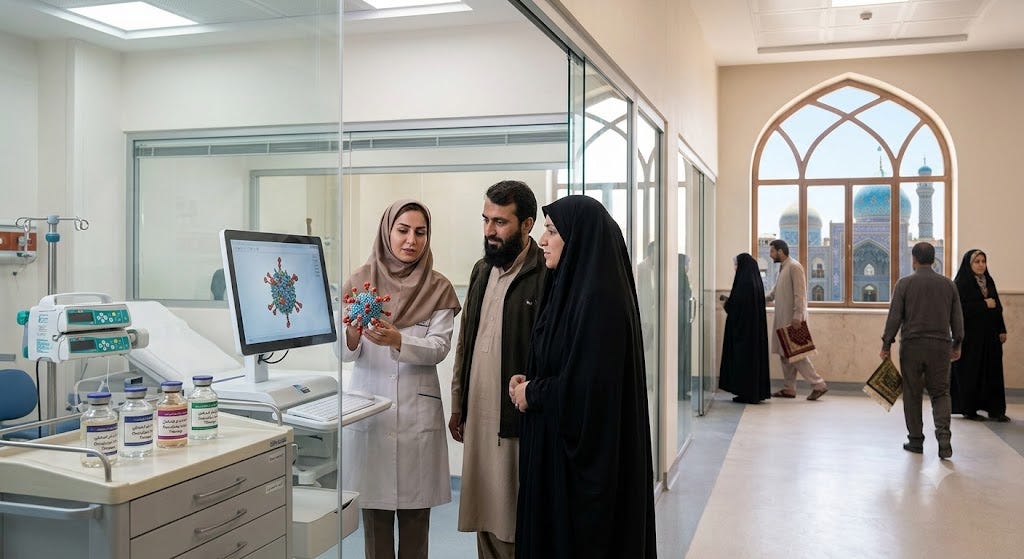
For millions of Shia Muslims around the world, travelling to Iran is a journey of the soul. Seeking solace and spiritual renewal, pilgrims flock to the holy sanctuaries of Imam Reza (AS) in Mashhad and Lady Fatima Masuma (SA) in Qom. However, in recent years, this spiritual journey has increasingly been paired with a pursuit of physical healing, as Iran rapidly emerges as a global powerhouse in advanced medical tourism.
The latest milestone in this medical renaissance? A massive, homegrown breakthrough in treating incurable cancers using highly targeted, cancer-killing viruses.
The Science of Oncolytic Viruses
Recently unveiled during the anniversary of the founding of Jihad-e Daneshgahi (Academic Jihad), Iranian researchers at the National Cancer Research Institute announced the successful development of advanced local technology to design, engineer, and produce oncolytic viruses.
Unlike traditional chemotherapy, which often damages healthy tissues along with cancerous ones, oncolytic viruses are genetically modified to selectively target, replicate within, and destroy only cancer cells. The Iranian research team is taking this a step further by combining these therapeutic viruses with mesenchymal stem cells. These stem cells act as a microscopic “delivery vehicle,” guiding the virus directly to the tumor site while simultaneously helping to repair any damaged tissue around it.
This dual-action approach not only boosts the effectiveness of the treatment but drastically reduces the severe side effects typically associated with treating aggressive malignancies.
Hope for Treatment-Resistant Cancers
The new platform has already successfully produced its first oncolytic virus on a semi-industrial scale. Following highly successful laboratory and preclinical studies, the technology has now entered the clinical trial phase in Iran.
The treatment specifically targets patients suffering from treatment-resistant or advanced cancers—with trials focusing heavily on ovarian, prostate, bladder, and malignant brain tumors. Iran’s broader goal is to launch an entire platform for viral, gene, and cell therapies, bringing at least 15 new regenerative drugs to market and reducing reliance on expensive foreign medical technology.
What This Means for Pilgrims
For the global Shia community, this advancement represents a profound opportunity. Health tourism in Iran is already highly regarded for its affordability, world-class surgeons, and state-of-the-art facilities. Now, pilgrims facing devastating medical diagnoses do not necessarily have to look toward prohibitively expensive Western hospitals for cutting-edge regenerative treatments.
By choosing Iran for medical care, patients can receive some of the most advanced cancer therapies in the world while remaining in an Islamic environment. This allows travellers to seamlessly blend their clinical treatments with Ziyarat. There is a profound comfort in knowing that after receiving world-class medical care, a patient can walk into the courtyards of the holy shrines to pray for their recovery, finding both physical treatment and spiritual peace in the exact same journey.
Reference: PressTv