

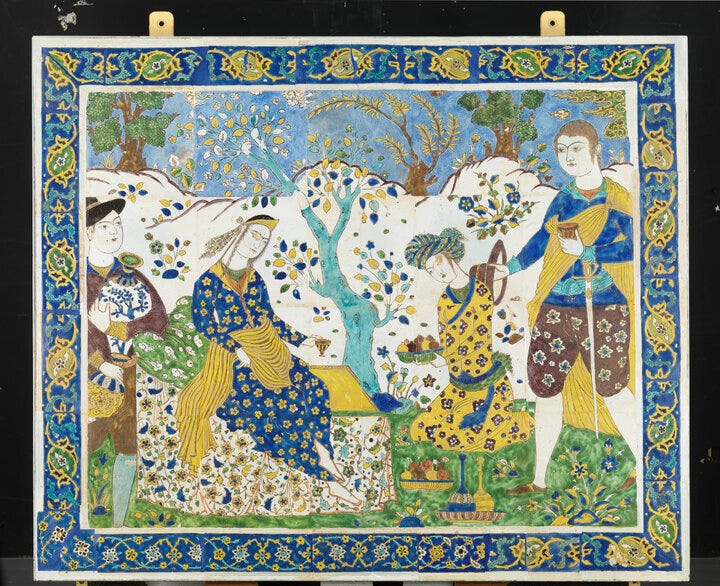
When we think of the Safavid dynasty—the pivotal era that established Twelver Shiism in Iran and gave us the breathtaking architectural jewels of Isfahan, Mashhad, and Qom—our minds immediately picture the magnificent mosques and shrines. We envision soaring iwans adorned with intricate arabesques, complex geometric patterns, and sweeping Quranic calligraphy. However, during the zenith of this Islamic golden age, Safavid artisans pushed the boundaries of ceramic art far beyond traditional architectural ornamentation, turning entire walls into vibrant, pictorial masterpieces.
From Sacred Geometry to Courtly Scenes
While religious buildings and shrines strictly maintained the aniconic traditions of vegetal motifs, geometry, and the Divine Word, the secular spaces of the 17th-century Safavid court told a different story. In royal residences, garden pavilions, and private palaces in the capital of Isfahan, tilework evolved into a dynamic visual medium. Instead of purely abstract patterns, square tiles were increasingly used to create large-scale pictorial compositions that depicted people, lush Persian gardens, and scenes of courtly leisure.
The Wall as a Canvas: A Masterful Puzzle
Creating these massive, continuous scenes was an extraordinary technical feat. Artists could no longer think of tiles merely as individual decorative blocks; the wall itself became the ultimate canvas. A large composition had to be meticulously divided into numerous smaller sections, with each individual tile functioning as a piece of a massive visual puzzle.
Preliminary design, precise colour coordination, human proportions, and the continuity of landscape elements across adjoining tiles were crucial. To achieve this without the vibrant glazes bleeding into one another, Muslim artisans utilised a sophisticated method known as cuerda seca (dry cord). Lines of a glaze-resistant material were applied to separate different colours. During the firing process, this separating material burned away, leaving striking dark outlines between the colored sections—a brilliant innovation that allowed for complex narrative art to be permanently set in clay.
Echoes of the Miniature Tradition
The subjects of these architectural murals were deeply intertwined with the rich tradition of Persian miniature painting. Garden gatherings, social interactions, and details of contemporary Safavid fashion were brought to life on ceramic walls.
One of the most breathtaking surviving examples of this art form is a large 17th-century tile panel, attributed to Isfahan and currently preserved at the Metropolitan Museum of Art in New York. Measuring over a meter in width and height, the panel is assembled from square tiles that form a single, continuous scene of a woman and three men enjoying a lush garden setting. It captures the elegance and social life of the era with the same delicate beauty found in the period’s illuminated manuscripts.
A Lasting Legacy
Today, these remarkable examples of Safavid pictorial tilework are preserved in major institutions worldwide, including the Met, the Louvre, and the Victoria and Albert Museum.
For those of us who travel to walk the historic streets of Isfahan or visit the sacred shrines of Iran, the legacy of the Safavid artisans is palpable. While the pictorial tiles remind us of the vibrant courtly life and the boundless creativity of 17th-century craftsmen, the geometric and calligraphic masterpieces continue to elevate the soul in spaces of worship. Together, they represent the dazzling duality of a golden age that forever shaped the spiritual, cultural, and artistic landscape of the Shia world.
Reference: Tehran Times