

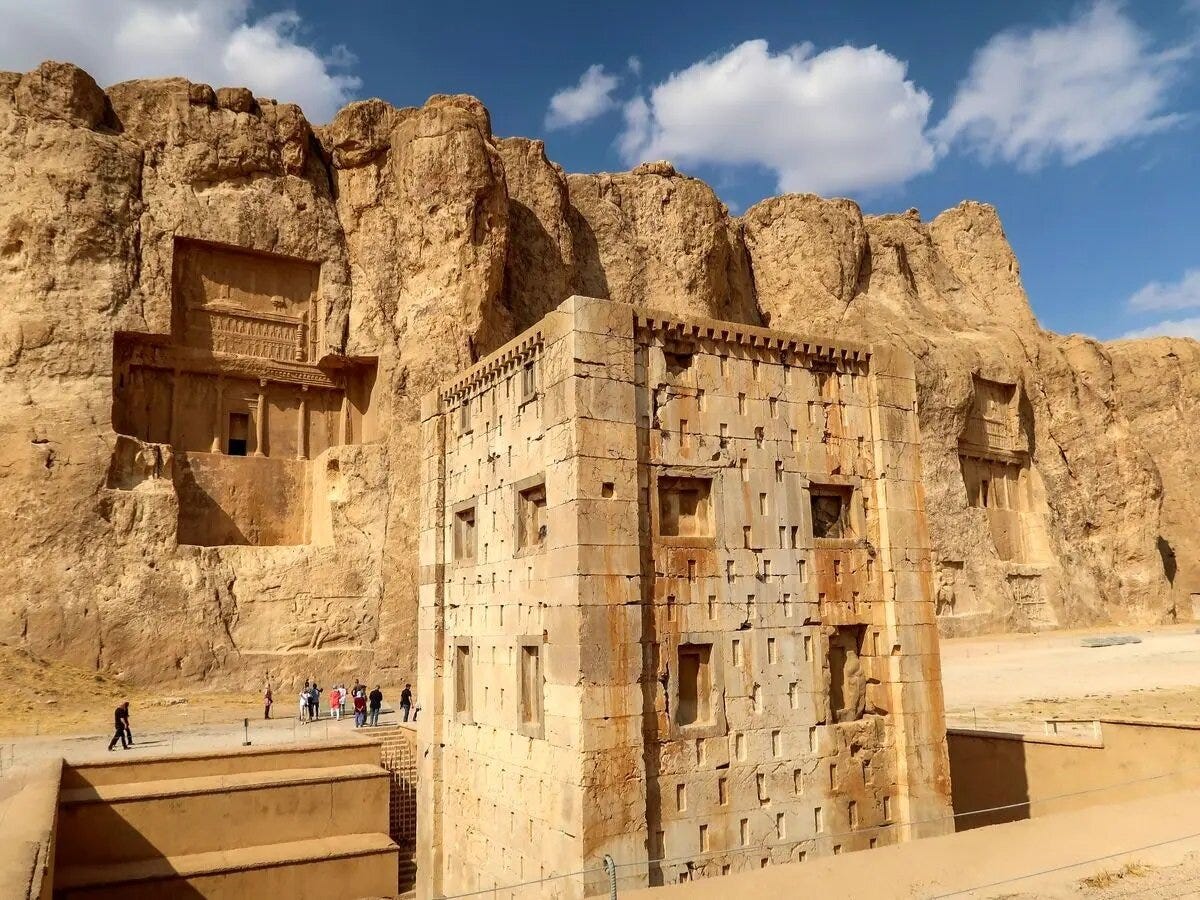
For travelers making the spiritual and cultural journey through the Fars province of Iran, the road near Persepolis offers a sight that defies scale. Carved high into the face of a vertical cliff stand four colossal crosses—the eternal resting places of the Achaemenid kings. This is Naqsh-e Rostam, a site where the silence of the desert meets the roaring history of ancient empires.
While the site has stood for millennia, it is currently witnessing a moment of renewal. After nearly eight years of delicate conservation work, the scaffolding is finally coming down from the Tomb of Xerxes I. Restoration experts have successfully stabilized the ancient rock, repairing damage caused by centuries of wind and rain, ensuring that this breathtaking monument remains safe for future generations to witness.
But Naqsh-e Rostam is far more than just a single tomb; it is a stunning open-air book of Iranian history that demands to be read in person.
A Convergence of Dynasties
Located just a short drive from the UNESCO-listed ruins of Persepolis (Takht-e Jamshid), Naqsh-e Rostam serves as a magnificent necropolis. As you approach the foot of the cliff, you are greeted by the sheer magnitude of the four cruciform tombs. Believed to belong to Darius I, Xerxes I, Artaxerxes I, and Darius II, these chambers were hewn directly into the rock face, suspending the kings high above the ground, closer to the heavens.
Below these silent watchers lie vibrant bas-reliefs from a completely different era—the Sassanian Empire (224–651 CE). These intricate carvings depict scenes of imperial grandeur, including the triumph of Shapur I over Roman emperors, serving as a reminder of the shifting sands of power in the region.
The Mystery of the Cube
Standing solitary in the foreground of the cliff is one of the site’s most enigmatic structures: the Ka’beh-ye Zardusht (Cube of Zoroaster). This distinct, square limestone tower, dating back to the 6th century BC, has puzzled historians for generations. Whether it was a royal tomb, a fire temple, or a repository for sacred texts, its precise architecture adds a layer of mystery to the sacred landscape.
The Myth of Rostam
The site derives its name, Naqsh-e Rostam (”The Picture of Rostam”), from a local legend. For centuries, locals believed the Sassanian carvings below the tombs depicted scenes from the life of Rostam, the mythical hero of the Persian epic Shahnameh. This blend of myth and tangible history gives the location a unique soul, bridging the gap between folklore and archaeology.
A Vital Stop on the Journey
For those visiting the holy shrines of Shiraz or exploring the deep heritage of Iran, Naqsh-e Rostam is an essential excursion. The completion of the restoration work on Xerxes’ tomb makes this an ideal time to visit. To stand at the base of these cliffs is to feel the weight of history—a reminder of the civilizations that have shaped the land long before the modern era.
Travel Tip: Naqsh-e Rostam is best visited in conjunction with Persepolis. The morning light often illuminates the cliff face beautifully, revealing the intricate details of the newly restored reliefs and the Faravahar symbols that guard the kings’ eternal sleep.