

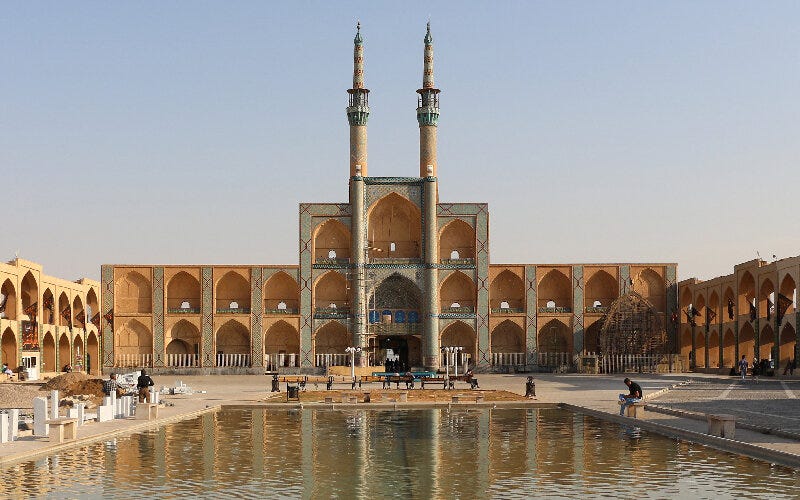
The desert heat begins to break just before Maghrib. As you walk through the winding, narrow alleys of Yazd, the high adobe walls radiating the warmth of the day, the scent of rosewater and brewing black tea pulls you forward. You turn a corner, and suddenly, the enclosed streets open up into a vast, breathtaking expanse: the Amir Chakhmaq square.
For a traveller, the sight is instantly humbling. Rising before you is the Takiyeh, a towering three-story facade of perfectly symmetrical arched alcoves. Its twin minarets stretch high into the cooling twilight sky, built centuries ago so the call to prayer could carry across the desert winds.
But as you stand in the square, mingling with the local families, shopkeepers, and fellow pilgrims settling near the fountains, you realise this isn’t just a historic monument you take a photo of and leave. You are standing in the spiritual epicentre of the “Hussainiya of Iran.”
The Shadow of the Nakhl
As you walk closer to the eastern side of the plaza, a massive structure commands your attention. It rests silently on the ancient stones, towering over eight meters high. This is the Nakhl—a giant, lattice-work wooden structure shaped like a cypress tree, an ancient Persian symbol of eternity and resilience.
Standing beneath its heavy wooden beams, it’s impossible not to feel the weight of what it represents. In Shia tradition, the Nakhl is the symbolic coffin of Imam Husayn (AS). For most of the year, it sits quietly, a sleeping giant awaiting the month of Muharram.
If you are fortunate enough to be here on the day of Ashura, the square transforms. The quiet awe of the evening is replaced by a tidal wave of shared grief. You would see this massive structure draped in black cloth, decorated with mirrors and swords. You would hear the rhythmic, thunderous beating of chests and the unified cries of “Ya Husayn.” You would watch in awe as hundreds of men slip their shoulders under the heavy wooden beams, lifting the massive structure and moving it in a rhythmic, circular procession.
Standing there, you wouldn’t just be watching history—you would be a part of it, bound to the people around you by a shared devotion to the Lord of Martyrs.
A Sanctuary Built by Devotion
As the sun finally dips below the horizon, the alcoves of the Takiyeh light up with a warm, golden glow.
You think of Seti-Fatemeh Khatoon, the devout wife of the 15th-century governor who co-founded this complex. She didn’t just want to build a mosque; she wanted to build a sanctuary for the people—a place for public baths, caravanserais, and deep underground reservoirs (ab-anbars) to sustain the city with cool water.
When the adhan (call to prayer) finally echoes from the minarets above, weaving through the arches and settling over the crowds, you feel exactly what Seti-Fatemeh intended. Surrounded by the gentle murmur of people preparing for prayer in the heart of the Iranian desert, you feel completely, unshakeably at home.
Reference: Tehran Times