

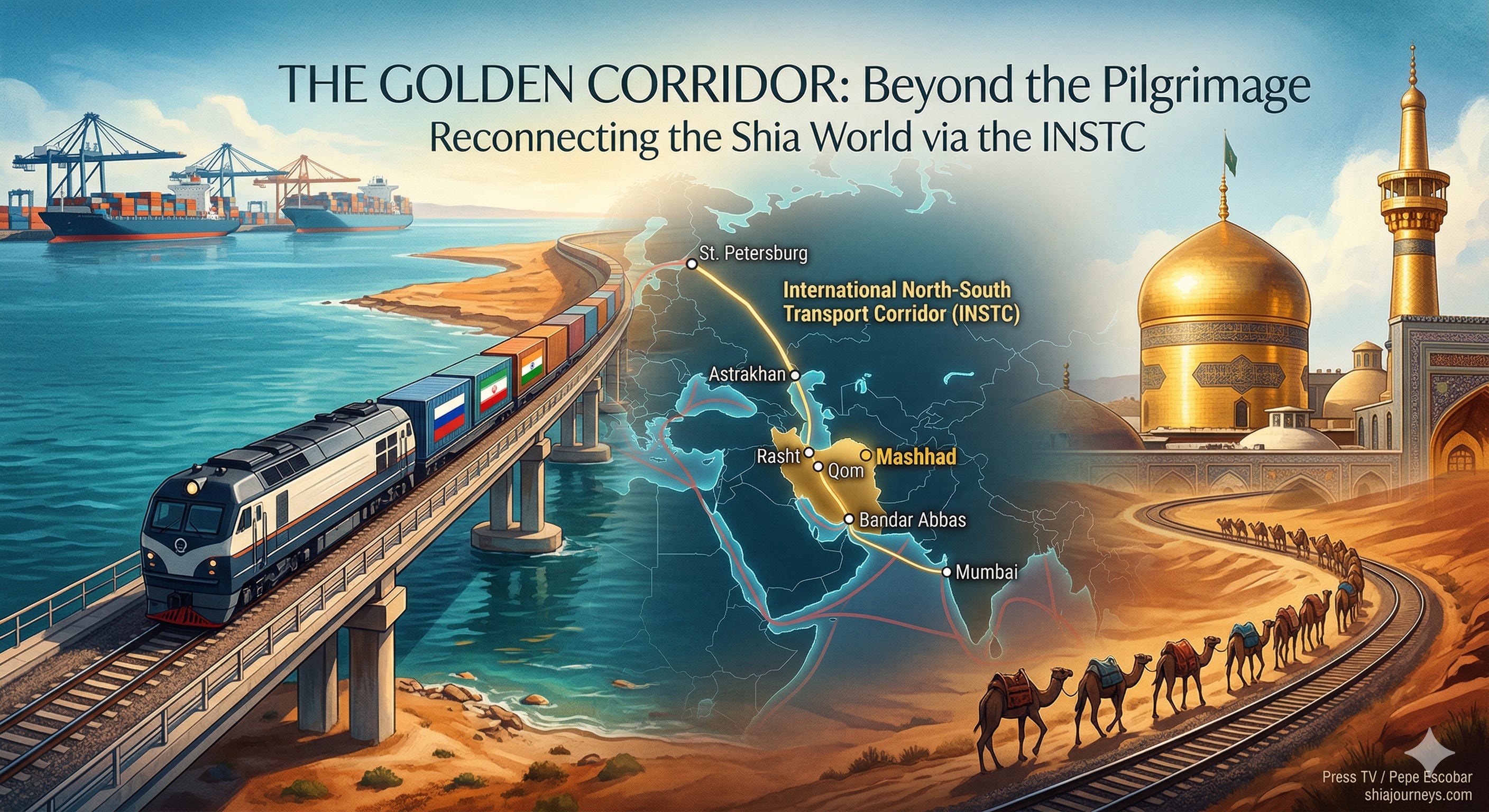
For the modern traveller, a journey through Iran is often a spiritual one—moving between the gold-domed shrines of Qom and the vast sanctuary of Imam Reza (as) in Mashhad. But a new documentary by Press TV, “Golden Corridor,” reveals that these sacred geographies are now becoming the backbone of a massive global project: the International North-South Transport Corridor (INSTC).
A Path for Pilgrims and Prosperity
As veteran analyst Pepe Escobar explores in the film, the infrastructure being built today—high-speed rails, massive ports like Bandar Abbas, and new Caspian shipping routes—does more than move containers. It restores the historical role of the Shia heartland as the “bridge” of the world.
For the Shia Journeys community, this means:
Easier Access to Sacred Sites: The completion of the Rasht-Astara railway (a key focus of the film) will eventually allow for seamless rail travel from Europe and Russia directly into the heart of Iran’s religious centres.
Economic Resilience: The documentary highlights how this corridor allows the Islamic Republic to bypass Western sanctions, ensuring the continued upkeep and expansion of the Haramain (holy shrines) and religious seminaries that millions depend on.
Cultural Exchange: By linking India (home to a massive Shia population) with Iran and Azerbaijan, the “Golden Corridor” is reviving a cultural and spiritual “Shia Crescent” that has existed for centuries but was interrupted by modern borders.
The Geography of Faith
Escobar argues that we are witnessing the end of the “Middle East” as a Western concept, replaced by a self-reliant West Asia. In the film, we see the strategic Shahid Rajaee port—a gateway that not only feeds the economy but also symbolises a nation standing on its own feet.
For those of us who journey to these lands for faith, the “Golden Corridor” represents a future where the path to the Imams is supported by a strong, interconnected, and sovereign Eurasian network.


