

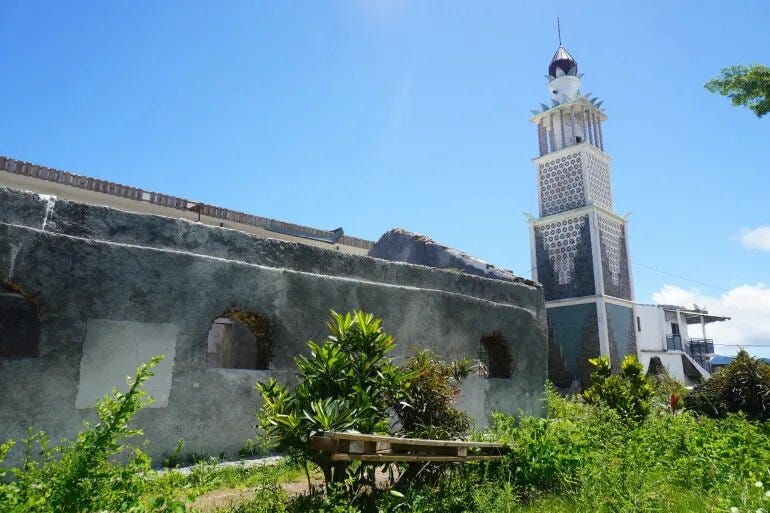
Introduction: A Hidden Jewel of the Ummah
When we think of Islamic heritage in France, the mind often drifts to the grand mosques of Paris or the bustling Muslim communities of Marseille. However, thousands of kilometres from the European mainland, nestled on the western coast of the Indian Ocean island of Mayotte—a French overseas department—stands a profound testament to the enduring global reach of the Ummah.
The Tsingoni Mosque is not only the oldest mosque in France still in active use, but its very walls hold secrets that are fundamentally rewriting the history of how Islam arrived on these shores. For Muslim travellers and seekers of Islamic history, the Tsingoni Mosque offers more than just a place of prayer; it is a living stone document of faith, cultural exchange, and the spiritual journeys of early believers.
Rewriting the Historical Narrative: Islam Before the Sultans
For centuries, traditional historical narratives suggested that Islam and civilisation were brought to the Comoros archipelago, specifically Mayotte, by ruling Sultans in the 16th century when Tsingoni became the island’s capital.
However, recent meticulous excavations conducted by the French National Institute for Preventive Archaeological Research (Inrap) in 2023 have upended this timeline. Archaeologists discovered that the roots of the settlement, and indeed the Islamic faith, stretch back to the 12th century. The evidence is clear: the light of Islam illuminated this region centuries before the rise of the Sultanate, proving that the faith was carried not by conquest or royal decree, but by the organic, grassroots networks of early believers.
Maritime Trails of Faith: The Omani and Iranian Connection
Perhaps the most captivating revelation for the readers of Shia Journeys is the geographical origin of these early believers. According to Martial Pauly, a historian at the French National Institute of Oriental Languages and Civilisations (Inalco), Islam entered Mayotte gradually during the 11th and 12th centuries via vast maritime trade networks.
Historical evidence suggests that sailors from Oman, and potentially Iran, were the harbingers of this new faith. During an era when traditional animist beliefs dominated the region, these Persian and Arab navigators brought with them the teachings of the Divine, peacefully integrating the message of Tawheed into local communities through trade, dialogue, and exemplary character.
Coral Architecture and the Shafi’i Legacy
As the Muslim community flourished, so did their architecture. Following the initial 12th-century settlement, a stone mosque was erected in the 14th century. Built using coastal sandstone, basalt, and ocean coral, the structure mirrors the breathtaking coral mosques found along the East African coast during the same period.
By the 16th century, during the prosperity of the Sultanate, the mosque was significantly expanded. In 1538, a historic mihrab was added, bearing the name of the ruler, Sultan Ali Muhammad. Excavations and artefact analyses have also confirmed that the historical inhabitants of Tsingoni followed the Shafi’i school of thought, a madhab that historically dominated the maritime trade routes of the Indian Ocean.
The Quran and the Nail: A Profound Symbol of Devotion
One of the most spiritually evocative discoveries made inside the mosque’s walls was a deeply personal artefact: a page of the Holy Quran buried carefully alongside a wooden nail from the building’s structure.
Justine Saadi, the project’s scientific director, noted that this unique combination likely occurred during an ancient restoration phase. It represents a poignant intersection of faith—a blending of Islamic devotion with local traditions of seeking divine protection. For the believer, finding the sacred words of the Quran literally built into the foundations of the house of Allah serves as a beautiful reminder of how deeply the love for the Divine was woven into the daily lives and physical spaces of early Muslims.
A Destination for the Spiritual Traveller
Though Tsingoni’s prominence waned in the 18th century due to regional tensions and the eventual transfer of Mayotte to French sovereignty in 1841, its spiritual legacy remains unbroken. Today, the Tsingoni Mosque stands as a resilient symbol of the Ummah’s vast, interconnected history.
For those travelling to uncover the hidden gems of Islamic heritage, Mayotte offers a profound reminder: the message of Islam was carried across oceans on the ships of pious sailors, taking root in coral and stone long before modern borders were ever drawn.
Reference: ABNA24