

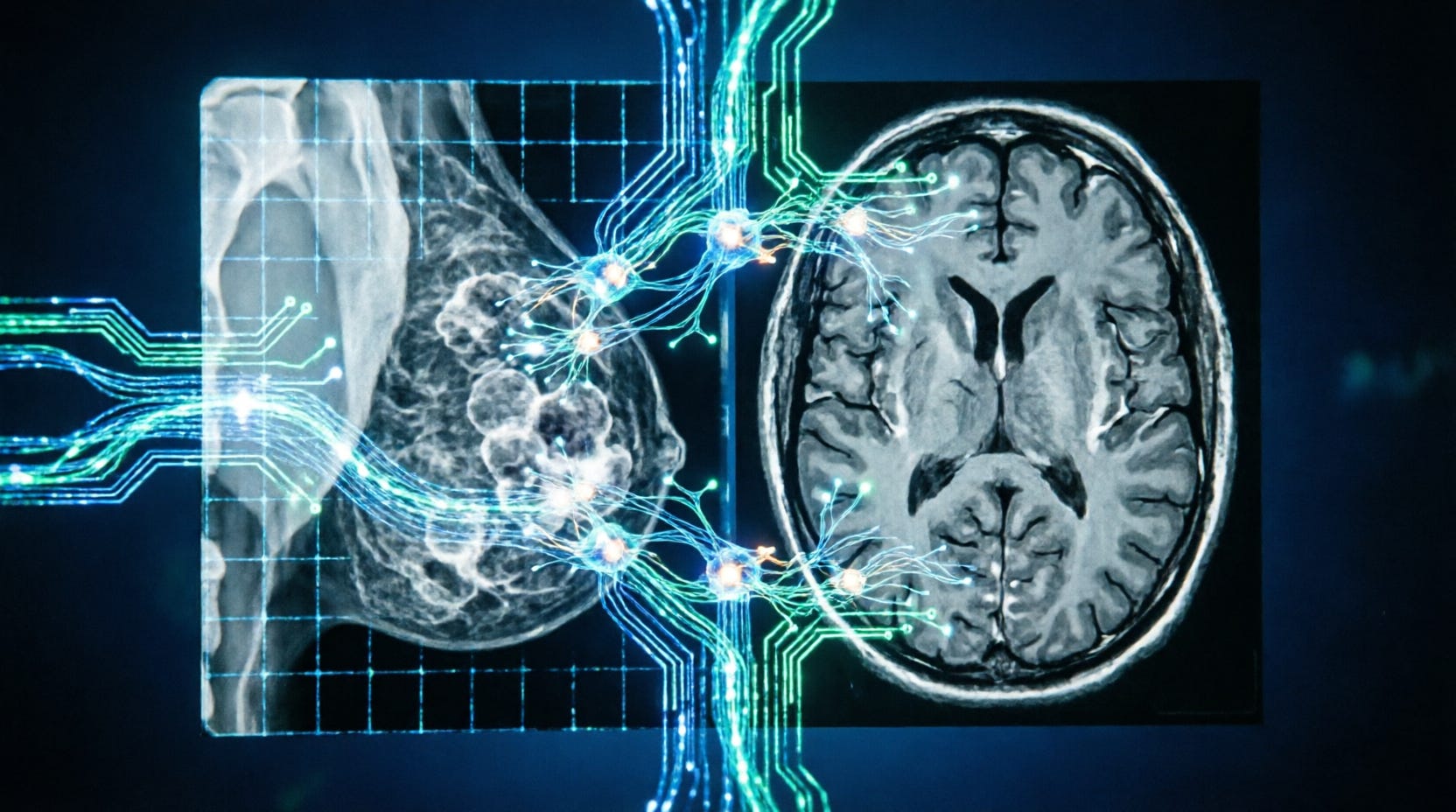
The Promise of Early Detection
Cancer remains one of the most significant health challenges worldwide, affecting millions of lives each year. The key to improving survival rates and treatment outcomes often lies in early and accurate detection. Now, groundbreaking advances in artificial intelligence are opening new doors for more precise cancer diagnosis through medical imaging.
How the Technology Works
Researchers have developed an innovative AI-based system that enhances the way medical images are analysed for cancer detection. This sophisticated approach combines multiple advanced technologies:
Deep Learning & Pattern Recognition: The system uses neural networks to identify and isolate suspicious areas in medical images, much like how an experienced radiologist examines scans, but with enhanced precision and consistency.
Feature Extraction: Once potential tumours are identified, the technology extracts critical characteristics including:
Geometric properties of cells
Spatial relationships within tissue
Textural patterns that distinguish cancerous from healthy tissue
Intelligent Filtering: The system eliminates unnecessary data while preserving the most important diagnostic features, allowing AI models to focus on what truly matters for accurate diagnosis.
Advanced Analysis: Using fuzzy neural networks and machine learning algorithms, the technology can handle uncertainty in cases where the boundaries between healthy and cancerous tissue are difficult to distinguish—a common challenge in medical imaging.
Cancers This Technology Can Detect
The system has shown particular promise in detecting:
Breast Cancer (through mammography and pathology images)
Brain Cancer (via MRI and CT scans)
Blood Cancers (through analysis of blood cell images)
Why This Matters for Patients
Improved Accuracy: The AI system consistently outperforms conventional diagnostic approaches, reducing the risk of false negatives and missed diagnoses.
Earlier Detection: By identifying subtle patterns that may be difficult for the human eye to catch, the technology enables earlier intervention when treatment is most effective.
Better Clinical Decisions: Healthcare providers receive more reliable diagnostic information, supporting smarter treatment planning and patient care.
Reduced Uncertainty: The system’s ability to handle ambiguous cases helps reduce diagnostic uncertainty, giving both doctors and patients more confidence in results.
The Bigger Picture
With cancer claiming over 10 million lives globally each year, advances in diagnostic technology are crucial for improving outcomes. AI-powered tools like this represent a significant step forward in the fight against cancer, offering:
More accessible screening in areas with limited specialist availability
Consistent analysis that doesn’t fatigue
The ability to process and compare vast amounts of imaging data
Support for healthcare professionals in making critical diagnostic decisions
Important Considerations
While AI technology shows tremendous promise, experts emphasise that its effectiveness depends on:
High-quality, standardised medical data
Proper validation and testing
Integration with clinical expertise
Continued investment in healthcare data infrastructure
What This Means for You
As AI-powered diagnostic tools continue to evolve and enter clinical practice, patients can look forward to:
More accurate screening results
Faster diagnosis
Personalised treatment approaches
Better monitoring during and after treatment
The Bottom Line: Advances in AI-based cancer detection represent hope for millions of people worldwide. While technology alone isn’t the answer, when combined with skilled healthcare professionals and quality medical care, it offers powerful new tools in the ongoing fight against cancer.
Stay informed about the latest health innovations. Regular screening and early detection remain your best defence against cancer. Consult with your healthcare provider about appropriate screening schedules based on your individual risk factors.