

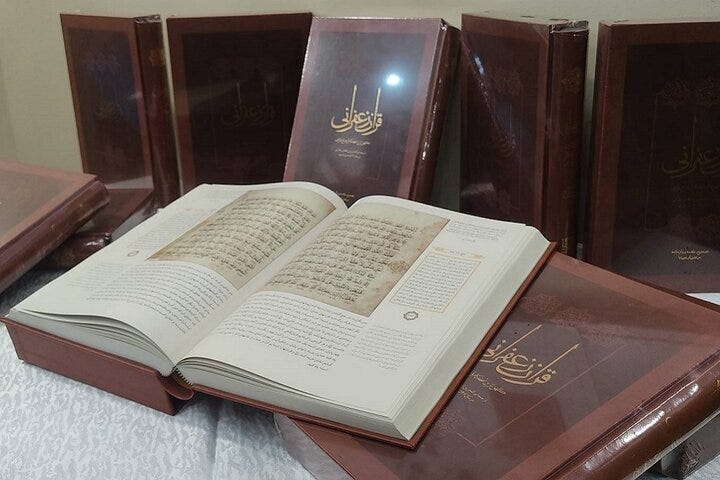
In a beautiful testament to the endurance of Islamic heritage, the National Library and Archives of Iran in Tehran recently hosted a profound gathering to unveil a meticulously crafted facsimile of the “Zaferani Quran”. Esteemed by scholars as the oldest known complete and dated manuscript of the Holy Quran featuring a Persian translation, this masterpiece bridges the gap between divine revelation and early Persian literary culture.
A Glimpse into the 12th Century: The original manuscript, a treasure safely preserved at Tehran’s Reza Abbasi Museum, was beautifully copied in the historic city of Rey in 546 AH (1151-52 CE) by the hand of Abolfazl Zaferani. Visually, the text is a stunning work of devotion; it features a delicate interlinear format where the Persian translation is inscribed in a smaller script nestled intimately between the lines of the Arabic text. Researchers closely associate this specific translation with the Quranic commentary authored by the esteemed 11th-century scholar Abu Bakr Atiq Nishapuri (Surabadi).
An Eight-Year Journey of Dedication: Bringing this historic artefact to the modern public without risking the original text was a massive labour of love. Manuscript scholar Morteza Kariminia revealed that creating this high-quality facsimile was a painstaking journey, taking nearly eight years to complete. The dedicated team relied on advanced colour calibration techniques to ensure the reproduction captured the exact physical characteristics and distinctive colours of the original ancient pages.
A Living Witness to Islamic and Persian Heritage: During the unveiling ceremony, prominent voices celebrated the Zaferani Quran not merely as a static museum piece, but as a living witness to Iran’s rich intellectual and cultural history. It reflects the profound, historical connection between the Islamic sciences and the Persian language.
Speaker Sayyed Mohammad Emadi Haeri noted that the manuscript highlights how early Islamic scholars legitimised translating the Quran into Persian, an intellectual milestone that profoundly shaped the region’s religious literature.
Renowned Persian literature scholar Mohammad Jafar Yahaqi remarked that the sixth century AH represented a golden age for Persian Quranic translation and exegesis. He emphasised that manuscripts like the Zaferani Quran serve as invaluable evidence of the symbiotic relationship between Islamic scholarship and the growth of Persian literary culture.
For linguists, the text acts as a rich repository of early Persian vocabulary and expressions, preserving classical words that gracefully captured the essence of the Quranic concepts during the medieval Seljuk period.
Through this remarkable facsimile, a rare window has been opened for scholars, travellers, and spiritual seekers alike to connect with centuries of devout scholarly endeavour and witness the enduring contribution to Quranic scholarship.
Reference: Tehran Times