

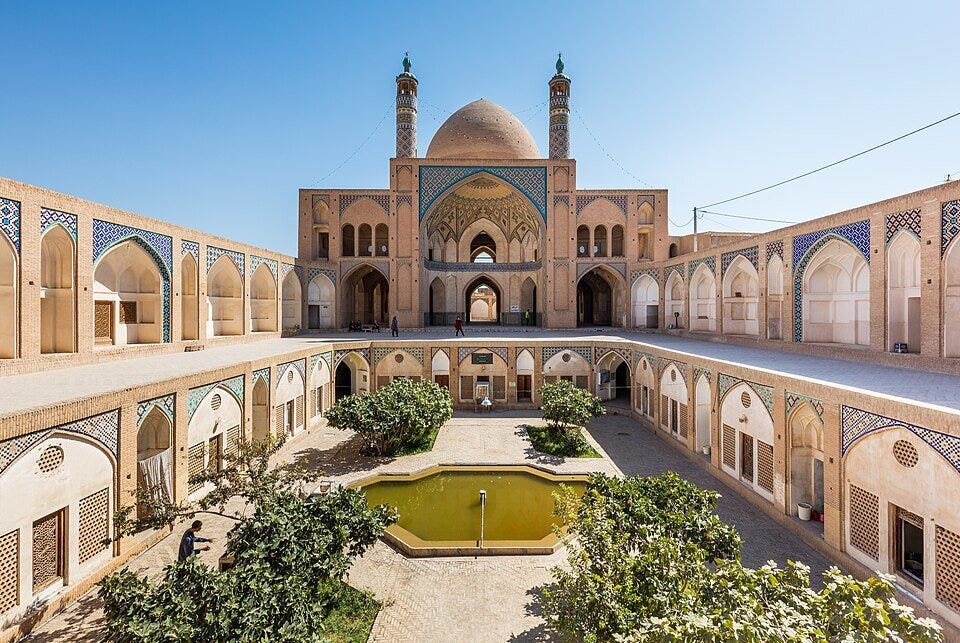
For the Shia traveller, the city of Kashan is often a stop on the road between the holy city of Qom and the artistic splendour of Isfahan. Yet, nestled within its historic clay-colored streets lies a sanctuary that serves as a profound testament to the Shia intellectual tradition: the Agha Bozorg Mosque and Madrasa.
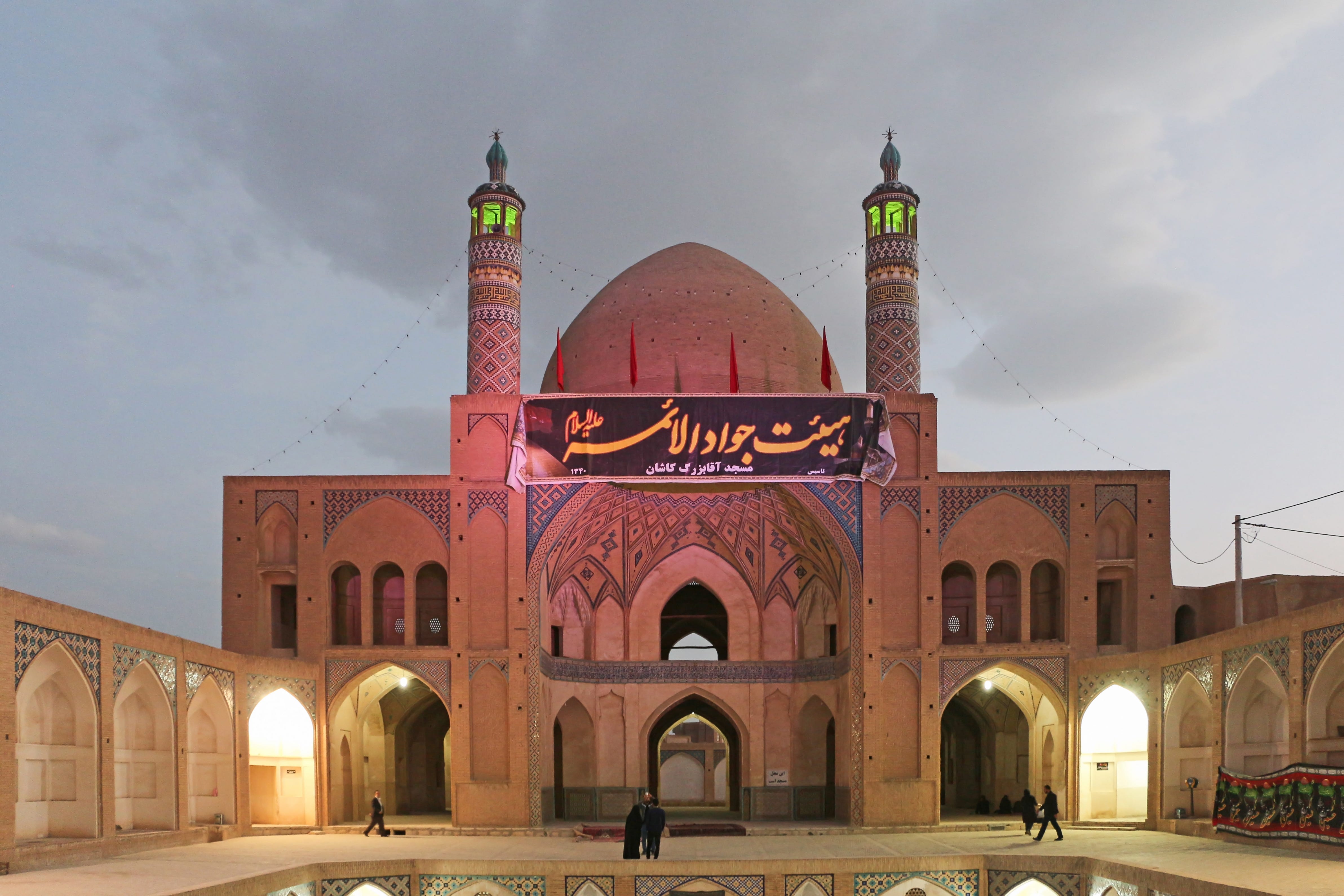
More than just a monument of brick and tile, Agha Bozorg is a “living” structure where the pursuit of divine knowledge (ilm) and the aesthetics of Islamic architecture converge into a single, breathtaking ensemble.
A Legacy of Scholarship
Constructed in the late 18th century and completed around 1832, the complex was built for Mulla Mahdi Naraqi II, a celebrated Shia theologian and jurist known as “Agha Bozorg.” The Naraqi family holds a distinguished place in Shia history, particularly for their contributions to ethics (akhlaq) and jurisprudence.
Walking through the gates today, one can still feel the weight of this scholarly heritage. The mosque was designed not only as a place for the communal Salat but as a rigorous center for learning, reflecting the Shia tradition where the mosque and the school are inseparable pillars of the community.
The Architecture of Contemplation
What immediately strikes the visitor is the mosque’s unique “sunken” design. Unlike the soaring elevations of Isfahan’s mosques, Agha Bozorg breathes with the desert. It is famous for its five-level construction and its dual courtyards.
The lower courtyard is a sunken garden, or goodal-baghcheh, which sits below street level. This design serves a dual purpose: it provides a natural cooling system against the fierce Iranian sun and creates a secluded, quiet environment for students residing in the surrounding chambers (hujras). At the centre lies a tranquil pool, a symbolic representation of purity and the “fountain of knowledge.”
Innovation and Artistry
The architectural language of Agha Bozorg is one of restraint and elegance. The use of simple brickwork, punctuated by delicate turquoise and light blue tiles, mirrors the humility of the scholars who once paced its corridors.
Key features for travellers to observe include:
The Windcatchers (Badgirs): Rising above the structure, these traditional Persian cooling towers channel the desert breeze into the lower levels, ensuring the sardab (subterranean space) remains cool even in mid-summer.
The Grand Iwan: The massive arched gateway is adorned with intricate muqarnas (stalactite-like carvings) and calligraphy that invites the faithful into a space of reflection.
The Great Dome: Unlike many Persian mosques, the dome here is supported by massive pillars that allow for an open, airy ambulatory. This creates a rhythmic play of light and shadow that changes throughout the prayer times of the day.
A Journey of the Soul
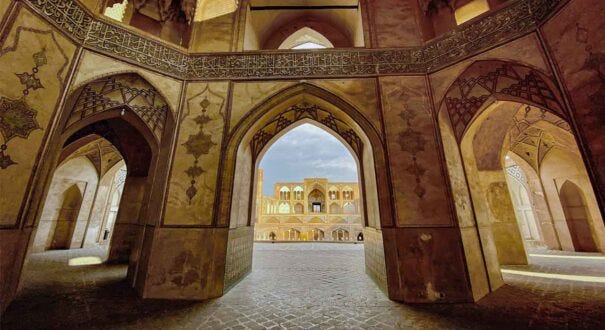
For those on a journey of faith, Agha Bozorg is a reminder that Islamic architecture is never purely decorative; it is a physical manifestation of spiritual philosophy. The transition from the bustling market streets of Kashan into the silent, sunken courtyard of the mosque mimics the internal journey from the distractions of the material world (dunya) to the stillness of the heart.
As you stand beneath the great dome or watch the reflection of the sunset in the central pool, you are witnessing the “Soul of Kashan”—a place where the legacy of the Ahl al-Bayt’s teachings continues to resonate through every brick and tile.
Traveller’s Tip: While visiting Agha Bozorg, take time to explore the nearby traditional houses of Kashan, such as the Tabatabaei House, to see how the same architectural principles were applied to domestic Shia life in the 19th century.