

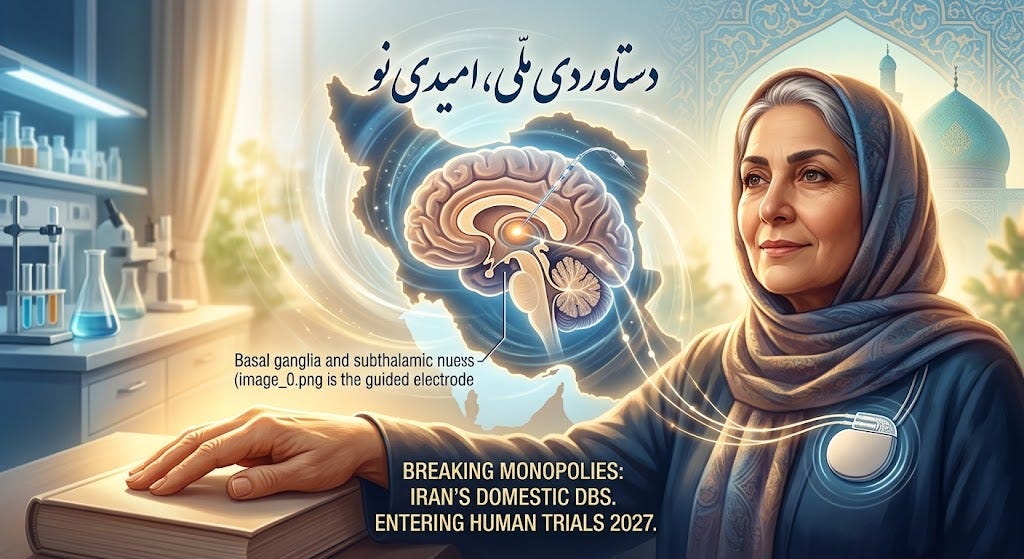
For thousands of families navigating the daily realities of Parkinson’s disease, severe tremors, and treatment-resistant depression, relief can often feel just out of reach when conventional medications stop working. But a major medical milestone is on the horizon that could change the landscape of neurological care.
After nearly ten years of quiet, rigorous research, Iran is preparing to launch human trials for its own domestically developed Deep Brain Stimulation (DBS) technology by the Iranian year 1406 (March 2027–March 2028).
It is a monumental step for local medical sciences—and more importantly, a beacon of hope for the patients who need it most.
The Root Problem: Erratic Signals
Deep inside the brain is a network of structures called the basal ganglia, which acts as a switchboard for coordinating smooth, intentional physical movements.
In a healthy brain, a chemical called dopamine acts as the messenger that keeps these signals flowing smoothly. In Parkinson’s disease, the cells that produce dopamine slowly die off. Without enough dopamine, the electrical signals in the basal ganglia become chaotic, hyperactive, and out of sync. This erratic electrical “noise” gets sent to the muscles, resulting in tremors, stiffness, and slow movement.
The Science of the “Brain Pacemaker”
To bypass this problem, Deep Brain Stimulation offers what is widely considered one of the most advanced frontiers in modern neuroscience. You can think of it much like a pacemaker, but for the brain.
Instead of permanently removing or destroying targeted brain tissue—which was the standard for older neurological surgeries—DBS relies on modulation. Thin electrodes are carefully implanted into the specific, misfiring regions of the brain. These electrodes deliver highly controlled electrical pulses that act like a “jammer,” blocking the chaotic, tremor-causing signals and allowing the healthy motor signals to get through.
Because the electrical pulses can be fine-tuned by physicians after implantation, the therapy is completely adaptable to a patient’s individual, changing needs. While it is most famous for treating the severe motor disruptions of Parkinson’s, DBS has also proven highly effective for conditions like dystonia, drug-resistant epilepsy, and even severe obsessive-compulsive disorder (OCD).
A Milestone 10 Years in the Making
Reaching this stage has required immense multidisciplinary expertise, bringing together neuroscientists, biomedical engineers, and advanced electronic systems specialists.
Ataollah Pourabbasi, Secretary of the Cognitive Sciences and Technologies Development Headquarters, recently shared that the project has successfully passed its preclinical phase. With initial animal testing complete, the team is currently at the crucial stage of implanting the electrodes in monkeys.
“We hope that if this stage proves successful and we pass the required tests, we will enter the human phase,” Pourabbasi noted, confirming the project is moving steadily along its planned timetable.
Independence in Healing
What makes this development particularly significant for the region is the technology’s exclusivity. Currently, only about five or six countries globally—primarily the United States and China—have managed to successfully commercialise DBS systems.
By localising this technology, Iran is breaking a monopoly on high-tech medical innovation and significantly reducing its reliance on costly imported equipment.
For the community, the impact is highly tangible: at least 2,000 patients in the country require DBS treatment every single year. By bringing the technology closer to home, this decade-long scientific journey is paving the way for a major transformation in accessible, life-changing care.
Ultimately, the journey of this technology from a quiet laboratory concept to a life-saving treatment is a testament to resilience and the profound tradition of seeking knowledge to serve humanity. As human trials approach, this breakthrough represents far more than just medical self-sufficiency; it is an answered prayer for many. For the thousands of families waiting for relief from the daily struggles of Parkinson's, it serves as a beautiful reminder that even in the face of daunting challenges, the pursuit of healing—and the light of discovery—continues to shine brightly.